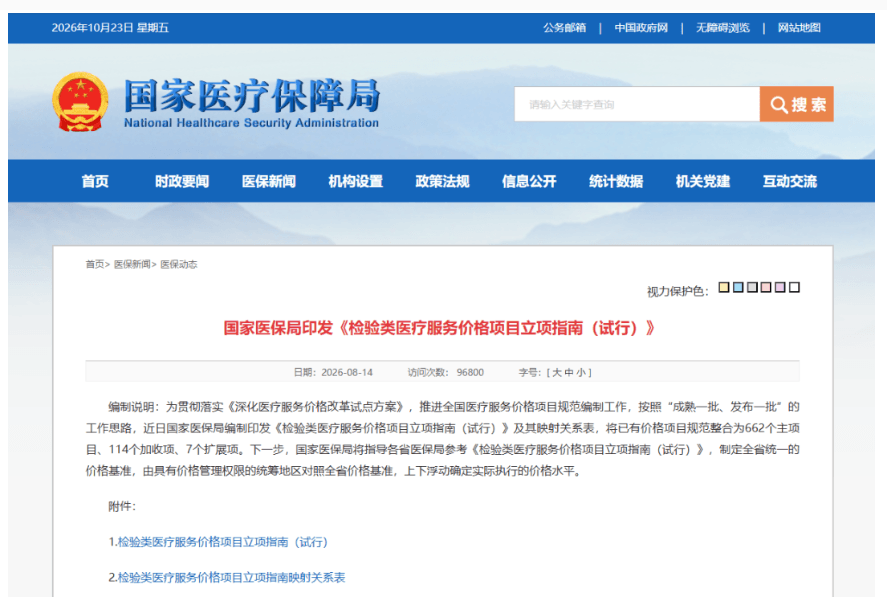
With the circulation of Beijing's second draft for public consultation on clinical laboratory testing prices, the benchmark samples for China's four-tier regional pricing framework are becoming more complete. Built on a unified national catalogue of testing items, regional pilot schemes are gradually taking shape, marking a shift from scattered provincial pilots toward a more standardized, region-based pricing system.
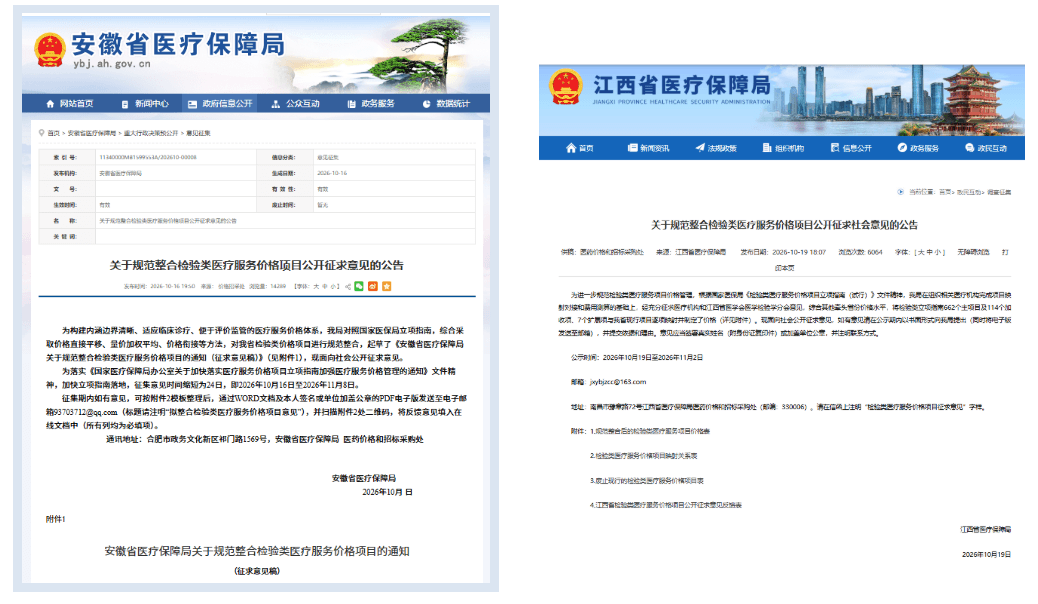
Following the release of local testing price reform plans in Anhui, Liaoning, and Jiangxi, the circulating second draft from Beijing provides a key reference for the highest pricing tier, completing an important part of the national pricing framework.
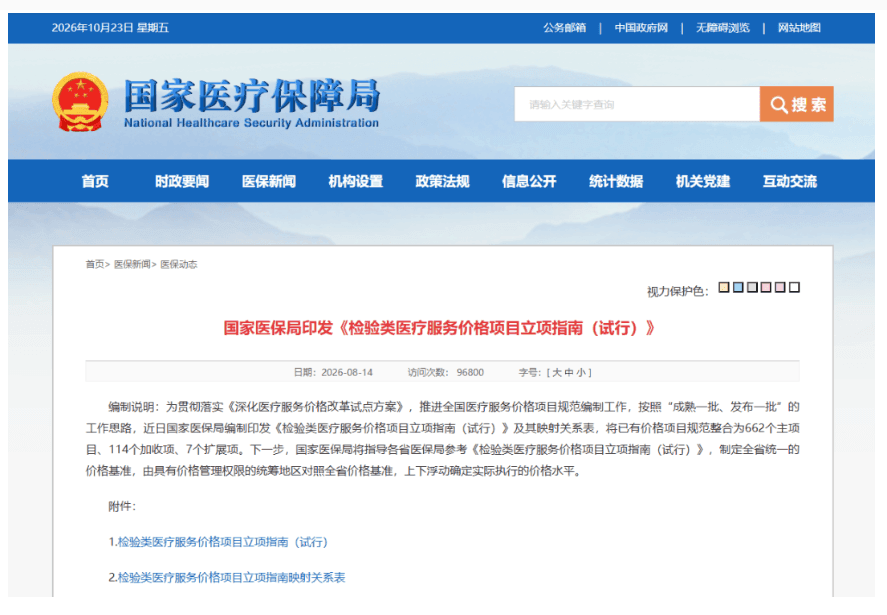
With reference samples from Beijing, East China, Central China, Northeast China, and other regions now available, pricing tiers, implementation rules, and provisions for innovation are becoming clearer under the unified framework of 662 testing items. China's IVD industry is entering a new phase of coordinated national reform with differentiated regional pricing.
The pilot programs in Anhui, Liaoning, and Jiangxi have provided practical references for the second and third pricing tiers, while the Beijing draft establishes a benchmark for the highest tier. The four-tier framework is moving beyond policy planning toward practical implementation, supported by reference prices and corresponding implementation guidelines.
Routine testing prices are not being increased simply because of regional economic differences.
For example, Beijing's urinalysis price is only RMB 6, lower than those in Anhui and Jiangxi. Its complete blood count price is higher than Anhui's but lower than Liaoning's within the same pricing tier.
Basic testing items remain subject to strict price controls, while greater pricing flexibility is reserved for more complex and innovative tests. Differences also exist within the same tier, with some basic testing items in Liaoning priced higher than those in Beijing, reflecting the greater weighting of labor costs in the region.
For tests requiring substantial manual interpretation, such as bone marrow morphology and D-dimer testing, Beijing's proposed prices are close to twice those in Anhui and Jiangxi.
These regional differences reflect variations in labor costs and provide an important basis for manufacturers when developing regional pricing strategies.
Pricing for molecular testing is becoming increasingly consistent across regions.
Nucleic acid amplification testing is uniformly set at RMB 80 across the four regions, while high-throughput tumor sequencing panels are generally priced between RMB 2,000 and RMB 2,200, leaving very limited regional price differences.
This trend significantly reduces the room for substantial technology-based price premiums in developed regions.
Unified Rules and Stricter Implementation Requirements
Anhui, Jiangxi, Liaoning, and Beijing share a common regulatory framework featuring a unified catalogue of 662 testing items, tiered discounts for combined testing, quality-control-related deductions, and bundled pricing for testing services and consumables.
Unified combined-testing discounts:
Up to 5 items: 20% discount
Up to 10 items: 30% discount
More than 10 items: 40% discount
Unified quality-control penalties:
Failure to upload testing data: 10% deduction, capped at RMB 5 per transaction
Failure to meet reference-range requirements: 5% deduction
Bundled pricing for testing and consumables:
Reagents, calibrators, and sampling consumables are included in the testing item price and cannot be charged separately.
Building on these common requirements, Beijing introduces stricter implementation measures, making it a benchmark for the highest pricing tier.
All additional charges are converted to fixed amounts, establishing clearer pricing boundaries and facilitating regulatory oversight and cost accounting. This model may become a mainstream approach nationwide.
Caps are introduced for multi-gene and multi-site testing. Tests covering more than nine sites are charged based on a maximum of nine, preventing excessive charges caused by adding more testing indicators. This will directly influence the development of combined-testing products.
Emerging technologies, including organoid-based drug sensitivity testing and long-read sequencing, retain independent pricing channels determined by medical institutions. Cities and provinces in the highest pricing tier may therefore become important testing grounds for the commercialization of new IVD products.
Conclusion
Clinical laboratory testing price reform is evolving from regional pilot programs into a systematic national framework featuring unified rules and differentiated regional pricing.
The industry is moving away from extensive growth models based on fragmented billing, premium-priced testing packages, and cross-regional pricing arbitrage. Competition is increasingly centered on three key factors: technological innovation, cost control, and regulatory compliance.
Companies that establish differentiated product portfolios and regional market strategies in advance will be better positioned to navigate this round of industry transformation.